Why did Jesus have to die on the cross for our sins?
During His life on earth, Jesus healed the sick, set people free, and taught them about the Kingdom of God. Yet He was arrested, sentenced to death, and nailed to a cross. Why did Jesus have to suffer so much? Why couldn't God simply forgive our sins without His Son having to die?
To answer these questions, we first need to understand the consequences of sin and why we need a Savior. Jesus died on the cross to bear the punishment for our sins so that we could receive forgiveness and have our relationship with God restored. His death on the cross was part of God's plan of salvation from the very beginning. In this Bible study, we will look at the final hours before Jesus' death, the meaning of His sacrifice, and what His finished work means for us personally.
Why did Jesus have to die for our sins?
God is holy and righteous. When we go against His will, we sin and become guilty before Him. The Bible teaches that everyone has sinned (Romans 3:23). You may have done many good things in your life, but those good deeds cannot undo your past sins. In Romans 6:23, Paul writes that the wages of sin is death. In other words, death is the punishment we deserve because of our sins. Sin has separated us from God, and we cannot restore that broken relationship through our own efforts. That is why Jesus came to earth. Unlike us, He never sinned. He did not have to die for sins of His own and could therefore give His life for others. Jesus told His disciples that He had come to serve and:
To give His life a ransom for many. (Mark 10:45)
A ransom is a price paid to set someone free. Jesus would redeem us not with gold or silver, but with His own life. This shows us how serious the consequences of sin are, but also how much God loves us. He was willing to give His own Son to save us.
Jesus knew what lay ahead
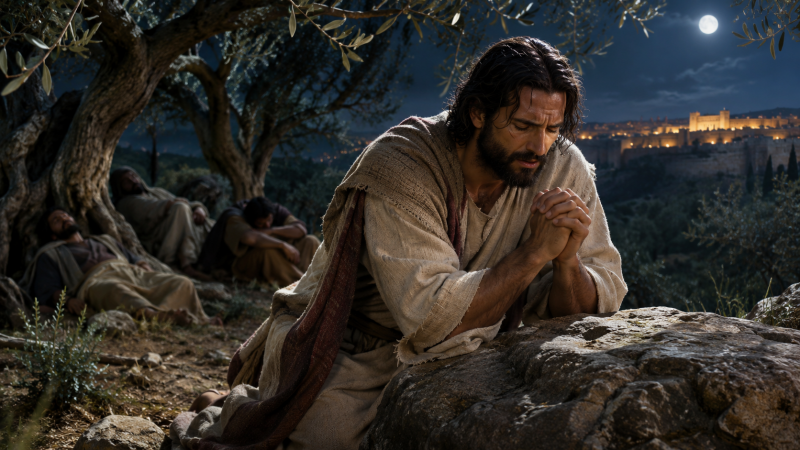
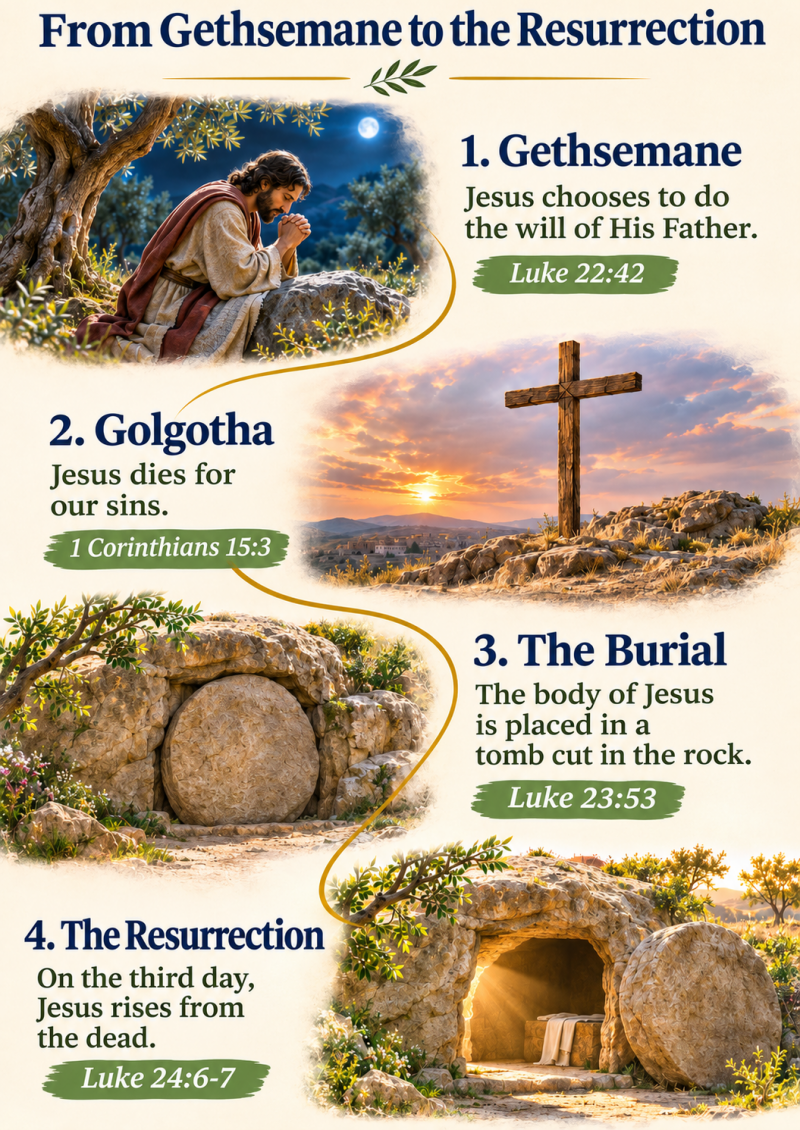
Long before Jesus was arrested, He knew that He would die. He told His disciples that He had to go to Jerusalem, suffer many things, be killed, and rise again on the third day (Matthew 16:21). Shortly before His arrest, Jesus celebrated the Passover with His disciples, a feast during which the Israelites remembered how God had delivered them from Egypt. Afterward, He went to the Mount of Olives, where He prayed to His Father in the Garden of Gethsemane. Luke describes how difficult this moment was for Jesus.
Father, if it is Your will, take this cup away from Me; nevertheless not My will, but Yours, be done. (Luke 22:42)
The cup Jesus spoke of represented the suffering that lay ahead. He knew what it would cost Him to bear our sins. Yet He chose to do His Father's will. It is important to understand that Jesus was not taken to the cross against His will. He willingly gave His life for us. His obedience to the Father and His love for us were so great that He was willing to go through all this suffering.
The guilty man went free, and the innocent One was condemned
After Jesus had prayed in Gethsemane, Judas arrived with a crowd to arrest Him. The disciples fled, and Jesus was taken away. He was accused, mocked, and eventually brought before Pontius Pilate, the Roman governor. Pilate questioned Jesus but found no fault in Him (Luke 23:4). Yet the people continued to demand His crucifixion.
During these events, we read about Barabbas, a man who was in prison for taking part in a rebellion and committing murder. The crowd demanded that Pilate release Barabbas and have Jesus crucified instead. Eventually, Pilate gave in to their demands (Luke 23:18-25). Barabbas, who was guilty of these crimes, was set free, while Jesus, who was innocent, was sentenced to death.
What happened here is a beautiful picture of what Jesus has done for us. Like Barabbas, we were guilty, while Jesus was innocent. Yet Jesus was willing to take our place so that we could go free.
What happened at Golgotha?
Crucifixion was a painful and humiliating form of execution used by the Romans. Jesus' suffering began long before He was nailed to the cross. The soldiers whipped Him, placed a crown of thorns on His head, and mocked Him (John 19:1-3). Jesus was then taken to Golgotha, a place near Jerusalem also known as the Place of a Skull. Along the way, Simon of Cyrene was forced to carry the cross behind Jesus (Luke 23:26).
At Golgotha, Jesus was crucified alongside two criminals. Among those standing near the cross were people who mocked Him and others who loved Him. What they could not see at that moment was what was happening spiritually: Jesus was bearing the sins of the world. Shortly before He died, Jesus spoke these words:
It is finished! (John 19:30)
Jesus then bowed His head and gave up His spirit. With these words, He made it clear that He had completed the work He had come to earth to do. He had paid the price for our redemption.
Jesus bore the punishment we deserved
Centuries before Jesus came to earth, the prophet Isaiah wrote about His suffering. He foretold that Jesus would be wounded for our sins and bear their consequences.
The chastisement for our peace was upon Him. (Isaiah 53:5)
In the following verse, Isaiah writes that the Lord laid the sins of us all upon Him (Isaiah 53:6). Jesus bore not only our sins but also the punishment we deserved because of them. This is what we call the substitutionary sacrifice of Jesus: He took our place so that we could receive forgiveness and have peace with God.
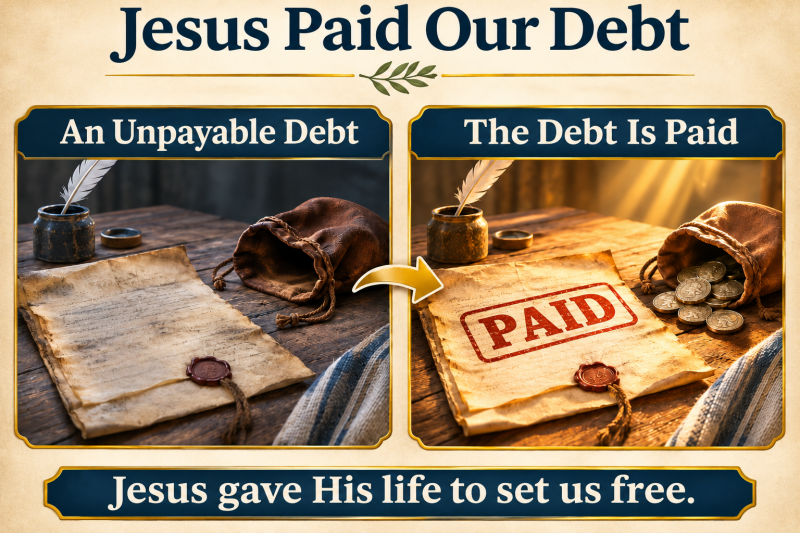
Imagine someone who has built up an enormous amount of debt. No matter how hard he works, he cannot pay it off completely. One day, someone comes along and decides to pay the entire debt for him. From that moment on, he no longer owes anything. His debt has not simply been canceled; someone else has paid it in full.
Although the guilt of our sins is far more serious than any financial debt, this example helps us understand what Jesus has done for us. We could not pay our own debt, but Jesus paid it for us—not with money, but by giving His life.
Through the blood of Jesus, we are reconciled to God
In Romans 3:25, Paul explains that God provided Jesus as the sacrifice for our sins, through faith in His blood. The blood of Jesus represents the life He gave for us. Through His sacrifice, our sins can be forgiven, and we can be reconciled to God. Reconciliation means that the relationship between God and humanity, which was broken by sin, is restored.
The Bible also speaks about justification. This means that God declares us righteous through faith in Jesus. He does not do this because we have never done anything wrong or because we have now done enough good works. He does it on the basis of the sacrifice of Jesus Christ. God does not simply overlook our sins. He forgives us because Jesus has borne the punishment for them. In this way, we see both God's love and His righteousness in the cross.
Jesus does not need to offer Himself again and again. In Hebrews 10:10-14, we read that He offered Himself once and for all. His sacrifice was enough. We do not need to add anything to it to receive forgiveness for our sins.
Jesus rose from the dead
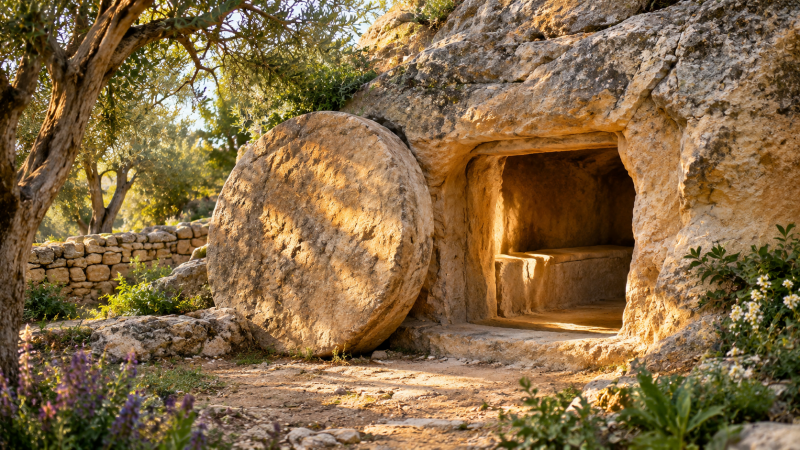
After Jesus died, Joseph of Arimathea asked Pilate for permission to bury His body. He wrapped Jesus' body in linen and laid Him in a tomb carved out of rock. A large stone was then rolled in front of the entrance (Matthew 27:57-60). This must have been an especially difficult time for the disciples. Although Jesus had told them that He would rise again, they did not yet understand what was about to happen.
On the third day, Jesus rose from the dead. He then appeared to several people, including His disciples. When Paul summarizes the message of the gospel in 1 Corinthians 15:3-5, he mentions not only that Jesus died for our sins but also that He was buried and rose again. The resurrection is an essential part of the gospel.
In Romans 4:25, we read that Jesus was handed over to death because of our sins and raised for our justification. Death could not hold Him. Jesus has overcome death and is alive today. We do not believe in a teacher who simply said wonderful things thousands of years ago. We believe in a living Savior through whom we can receive eternal life.
What does the sacrifice of Jesus mean for you?
Perhaps you have always known that Jesus died on the cross, but you have never stopped to think about the fact that He did this for you personally. Jesus did not give His life because we deserved it, but because God loves us. You do not have to become a better person before you can come to God. You can come to Him as you are, acknowledge your sins, and believe that Jesus bore the punishment for your sins.
This does not mean that you can continue living however you please. God calls us to faith and repentance. Repentance means turning away from sin and turning to God. His grace is not an excuse to keep sinning. Instead, it gives us every reason to love and obey Him.
What a privilege it is that we no longer have to live separated from God! Through faith in Jesus Christ, we can receive forgiveness, enjoy a restored relationship with God, and look forward to eternal life with Him. This is what Jesus has made possible for us through His death and resurrection.